By Dr. Humberto Fernandez Miro, MD | May 2026
If you haven’t kept up with what has happened in weight loss pharmacology over the past three years, it’s a lot to catch up on. The category that once meant phentermine and orlistat now includes medications producing 20 percent body weight loss, a newly approved oral pill with no food timing restrictions, and a cardiovascular outcomes trial that changed how medicine thinks about obesity treatment at the population level. For patients trying to understand their options, the landscape is genuinely different from what it was even recently.
This piece is an attempt to lay out where things actually stand in 2026, with particular focus on Foundayo, the newest entrant in the oral weight loss pill category, and how it fits relative to what came before it.
The medications driving most of the current conversation are GLP-1 receptor agonists. GLP-1 stands for glucagon-like peptide-1, a hormone your gut releases after eating that signals to your brain that you’re full, slows the rate at which your stomach empties, and helps regulate insulin release. For decades, this hormone existed in medicine primarily as an incretin relevant to diabetes management. Then researchers figured out how to build drugs that mimic it for extended periods, and the weight loss results were unlike anything the field had seen from a non-surgical intervention.
Semaglutide, sold as Wegovy for weight management and Ozempic for diabetes, produces an average of around 15 percent body weight loss over 68 weeks in clinical trials. Tirzepatide, sold as Zepbound for weight management and Mounjaro for diabetes, targets a second receptor alongside GLP-1 and produces average weight loss of 20 percent or more. Both are weekly subcutaneous injections. Both have strong cardiometabolic data alongside the weight loss numbers. And both require ongoing treatment to maintain results, which matters for how patients plan around them financially and practically.
The injectable format works well for many patients. It doesn’t work for all of them. Needle aversion is common and should not be dismissed as squeamishness. Weekly injections create logistical friction for frequent travelers, people with certain occupations, and anyone who genuinely cannot build a reliable self-injection routine. For that population, the oral options matter.
Oral semaglutide, branded as Rybelsus for diabetes and more recently as Oral Wegovy for weight management, was the first oral GLP-1 receptor agonist to reach the market. It works, but it comes with a demanding protocol. Because semaglutide is a peptide, the digestive system breaks it down before it can be absorbed unless specific conditions are met. Patients must take it on a completely empty stomach, with no more than a small sip of water, and wait at least 30 minutes before eating, drinking coffee, or taking other medications.
That protocol is manageable for patients with structured, predictable mornings. For patients with early work shifts, irregular schedules, young children, or any number of reasons their morning doesn’t follow a fixed routine, it creates consistent friction. In clinical practice, adherence to the food timing requirement is one of the primary reasons oral semaglutide underperforms for some patients relative to what trial data would predict. Inconsistent absorption leads to inconsistent drug levels, which produces inconsistent results.
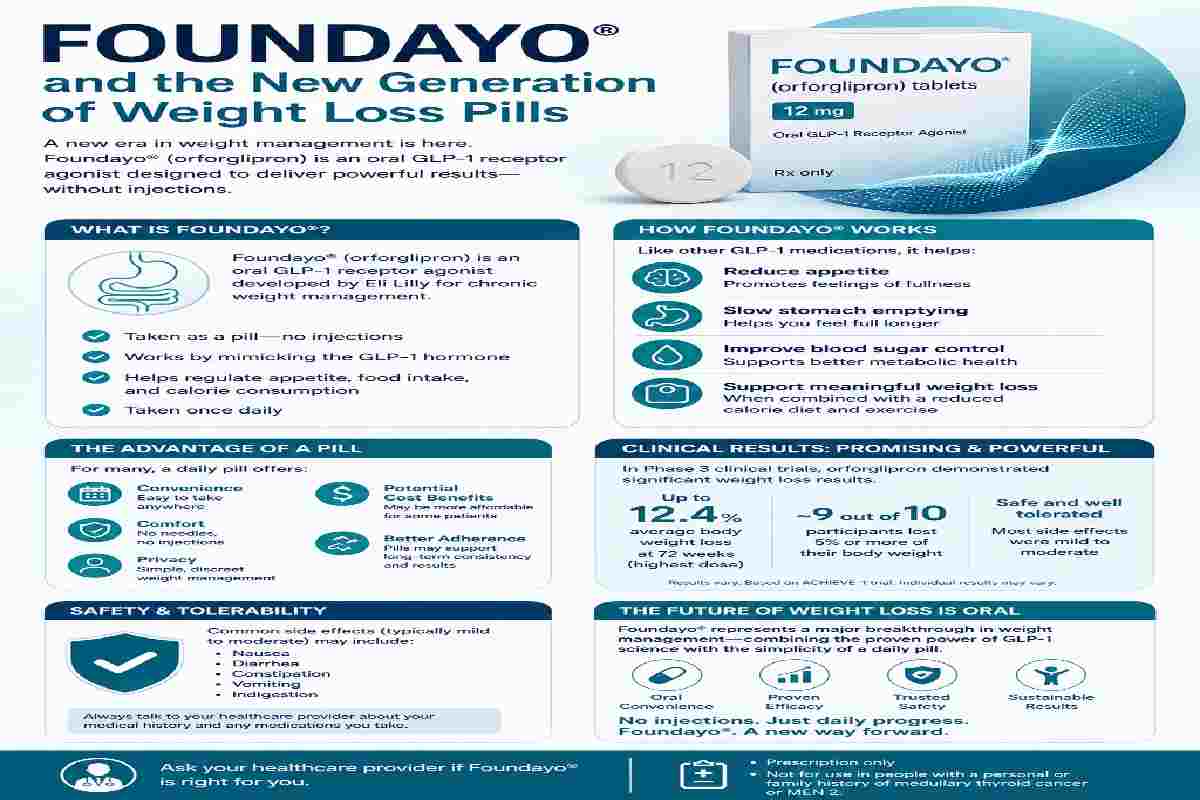
Foundayo, approved by the FDA in April 2026, contains orforglipron, a non-peptide small molecule GLP-1 receptor agonist. That distinction is the entire story of why Foundayo’s dosing instructions look so different from oral semaglutide’s.
Because orforglipron is not a peptide, the digestive system doesn’t break it down before it can be absorbed. It doesn’t need a controlled gastric environment or a staged absorption window. It reaches GLP-1 receptors through standard intestinal absorption pathways with a bioavailability that doesn’t shift meaningfully based on whether you ate breakfast first. The prescribing instructions are essentially: take it once daily, whenever works for you, with or without food.
For a daily medication that someone will take for years, that simplicity is not a trivial feature. Medication adherence over years is one of the strongest predictors of real-world outcomes in chronic disease management. The more conditions a medication requires, the more opportunities there are to miss them, and missing them consistently produces a real-world result that doesn’t match what the clinical trial showed.
The efficacy numbers for Foundayo are lower than for the injectable options. The ATTAIN-1 trial showed approximately 12.4 percent mean weight loss at 72 weeks at the highest dose, compared to roughly 15 percent for semaglutide and 20-plus percent for tirzepatide. That gap is real and worth being honest about. Foundayo is not the strongest option by efficacy alone. For patients where the injectable options are appropriate and accessible, those numbers favor the injections.
The more useful comparison for most patients considering an oral option is Foundayo versus oral semaglutide. The ATTAIN-3 trial ran that comparison directly in patients with type 2 diabetes over 52 weeks and showed orforglipron outperforming oral semaglutide 14 mg on both weight loss and glycemic control. No existing trial has run the comparison in a non-diabetic population over 72 weeks, so some uncertainty remains, but the head-to-head data that exists favors Foundayo.
As Dr. Quoc Dang, Medical Director and bariatric medicine specialist at WeightLossPills.com, has noted in his clinical writing: the real question is not which drug produces the strongest trial result, but which drug a specific patient will actually take consistently over years. For patients where the morning timing protocol of oral semaglutide has been a genuine barrier, Foundayo removes that barrier entirely.
GLP-1 weight loss pills share a class-wide side effect profile: nausea, constipation, diarrhea, vomiting, and abdominal discomfort are the most common, driven by the mechanism of slowed gastric emptying and altered gut hormone signaling. These effects are most pronounced during dose escalation and attenuate significantly once a dose is sustained for several weeks.
Foundayo’s nausea rates appear to run slightly higher than some other agents in the class based on trial data, though most cases are mild and transient and concentrated in the first weeks at each new dose level. The practical answer to GLP-1 nausea in any formulation is the same: titrate slowly, hold each dose long enough for the body to adjust, and resist the urge to escalate quickly in hopes of faster results. The patients who have the hardest time with GI side effects are almost always the ones whose titration moved faster than their tolerance allowed.
Standard contraindications apply across the class: a personal or family history of medullary thyroid carcinoma or multiple endocrine neoplasia type 2 are contraindications. Pancreatitis history warrants careful evaluation. Foundayo shares these contraindications with the injectable GLP-1 agents.
Foundayo’s out-of-pocket pricing through LillyDirect starts around $149 per month at the lowest dose and runs approximately $349 at therapeutic doses. Compared to injectable GLP-1 options at full retail, which often exceed $1,300 per month before insurance, that is a meaningfully different cost category.
The more significant access development is the Medicare GLP-1 Bridge program, which launched in July 2026 with a $50 monthly copayment for eligible Part D enrollees. Foundayo is one of three medications covered under that program. For Medicare patients who prefer an oral medication and meet the BMI and comorbidity eligibility criteria, that pricing changes the access equation considerably.
Commercial insurance coverage for all weight loss medications remains variable and is currently moving in the wrong direction for many patients, with a significant number of employer plans having dropped GLP-1 coverage in recent years. For patients without commercial coverage, the LillyDirect pricing for Foundayo is substantially below full pharmacy retail and represents one of the more accessible entry points into GLP-1 treatment currently available.
The choice between Foundayo, oral semaglutide, and the injectable options is not primarily a question of which medication has the best trial efficacy data, though that data matters. It is a question of which medication a specific patient will actually take, at the right dose, consistently, over a long enough period to produce meaningful results.
Patients with structured mornings who are comfortable with the oral semaglutide protocol and have no history of struggling with it have access to a medication with a slightly higher efficacy ceiling in the oral category. Patients who have tried oral semaglutide and found the timing protocol genuinely incompatible with their life, or who want the simplest possible daily regimen, have a clear case for Foundayo. Patients where maximum weight loss is the priority and injections are not a barrier should be having a conversation about tirzepatide.
None of these is the wrong choice for every patient. All of them are the right choice for some patients. The clinical conversation is about figuring out which patient you are, and that conversation goes better when you walk into it with a clear sense of what actually matters to you about how you take a daily medication.
___
Dr. Humberto Fernandez Miro, MD, is a family medicine physician and clinical researcher with 25 years of practice in Miami, FL. He is a contributing medical writer at WeightLossPills.com.




Sign up to receive exclusive content updates, fashion & beauty tips!

Copyright © 2026 All Rights Reserved By Health Glowera