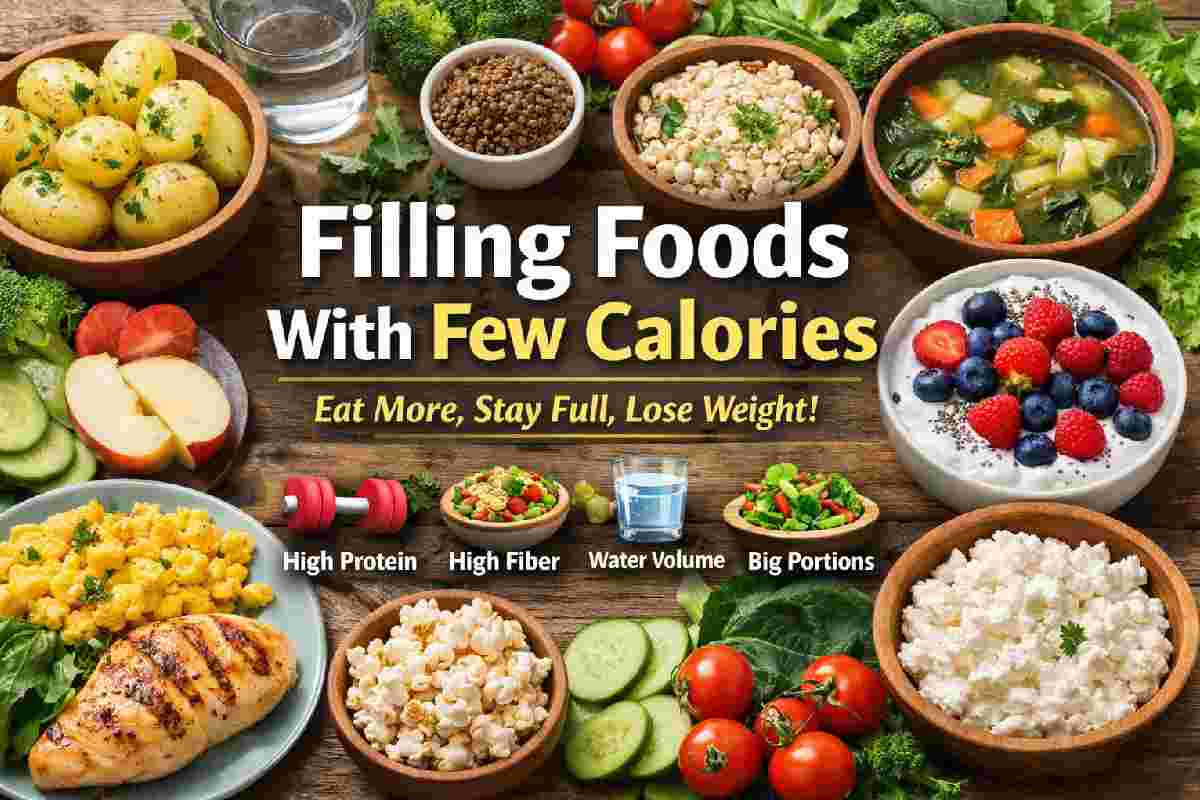
If you want to eat fewer calories without feeling miserable, stop chasing “diet foods” and start choosing high-satiety foods—foods that give you more fullness per calorie through protein, fiber, water, and volume.
That’s the real answer behind filling foods with few calories. If you’re constantly hungry while trying to lose weight, the problem usually isn’t “lack of willpower.” It’s that your meals are built around foods that are easy to overeat and bad at keeping you full.
The fix is surprisingly simple: choose foods that make your stomach and brain register “I’ve eaten enough” before calories climb too high.
Key Takeaways
- The best filling foods with few calories are usually high in protein, fiber, or water volume.
- Potatoes, Greek yogurt, eggs, soups, popcorn, beans, and fruit often work better than packaged “diet” snacks.
- Some low-calorie foods are still terrible for fullness, especially sugary drinks and ultra-processed snack foods.
- Full meals work better than random snacking when you’re trying to control hunger.
- The easiest meal formula is: protein + fiber + volume.
Why Some Low-Calorie Foods Keep You Full—and Others Don’t
This is where most articles oversimplify things.
A food can be low in calories and still leave you raiding the kitchen an hour later. Another food can have slightly more calories but keep you satisfied for half the day.
That difference comes down to satiety—how much fullness a food creates relative to its calorie load.
In practical terms, the most filling low-calorie foods usually do one or more of these well:
- High protein → slows hunger and improves meal satisfaction
- High fiber → adds bulk and slows digestion
- High water content → lets you eat more volume for fewer calories
- More chewing / less processing → often helps your brain register fullness better
That’s why a bowl of vegetable soup or Greek yogurt with berries usually beats a handful of crackers, even if the calories look similar on paper.
What Makes a Food Filling? A Simple Satiety Checklist
Before we get into the list, here’s the easiest way to judge whether a food is likely to keep you full.
1) Does it contain meaningful protein?
Protein is one of the biggest hunger-control tools you can use.
Foods that tend to work well:
- Greek yogurt
- eggs
- cottage cheese
- chicken breast
- fish
- tofu
- lentils
If a food is marketed as “healthy” but barely contains protein, don’t expect much staying power.
2) Does it contain fiber?
Fiber adds physical bulk and usually helps a meal feel more substantial.
Good fiber-rich picks:
- oats
- beans
- lentils
- apples
- berries
- popcorn
- vegetables
- chia seeds
3) Can you eat a lot of it for relatively few calories?
This is where food volume matters.
Examples:
- soup
- salad vegetables
- watermelon
- cucumbers
- mushrooms
- zucchini
- steamed potatoes
These foods physically take up more space, which can make meals feel more satisfying.
4) Is it a whole food—or basically pre-chewed?
Liquids and highly processed snacks are often easier to overconsume.
Usually less filling:
- juice
- sweetened coffee drinks
- “healthy” snack bars
- sugary cereal
- smoothies without protein/fiber
Usually more filling:
- whole fruit
- boiled potatoes
- eggs
- yogurt bowls
- soups
- stir-fries
Quick Satiety Grocery Checklist
Use this when shopping:
Buy more of:
- Lean proteins
- Beans/lentils
- Potatoes/oats
- Fruit
- High-volume vegetables
- Plain dairy or soy-based proteins
Buy less of:
- Liquid calories
- Sugary snack packs
- Low-protein “diet” foods
- Foods that are tiny but calorie-dense
Best Filling Foods With Few Calories
Here’s the list that actually matters in real life—not just in theory.
1) Boiled Potatoes
Potatoes are wildly underrated.
They get demonized because people associate them with fries or chips, but plain potatoes are one of the best examples of a filling food with relatively modest calories.
Why they work
- High water content
- Good volume
- Warm and satisfying
- More substantial than many “light” carbs
Best way to eat them
- Boiled or baked
- With Greek yogurt, cottage cheese, salsa, or a lean protein
- In a veggie bowl
What to avoid
- Deep frying
- Drowning them in butter, cheese sauce, or mayo-heavy toppings
Best for: lunch or dinner when you want a real meal, not a “diet plate.”
Greek yogurt is one of the easiest hunger-control foods because it combines protein, creaminess, and convenience.
Why it works
- High protein for the calories
- Easy to pair with fruit or chia
- Feels more satisfying than sugary yogurt cups
Best way to eat it
- Plain Greek yogurt + berries + cinnamon
- Add chia seeds or oats for more staying power
What to avoid
- Dessert-style yogurts with lots of added sugar
Best for: breakfast, snack, or post-dinner cravings.
3) Eggs
Eggs are simple, cheap, and hard to beat for satiety.
Why they work
- Strong protein-to-effort ratio
- Great for structured meals
- Help breakfast feel like a meal, not a placeholder
Best way to eat them
- Boiled eggs
- Veggie omelet
- Egg scramble with spinach and mushrooms
What to avoid
- Turning them into a calorie bomb with lots of oil and cheese
Best for: breakfast and quick snacks.
4) Oatmeal
Oatmeal is one of the best “comfort foods” that can still support appetite control.
Why it works
- Fiber-rich
- Warm and slow-eating
- Pairs well with protein and fruit
Best way to eat it
- Oats + protein source (Greek yogurt, protein powder, milk, soy milk)
- Add berries, chia, or apple
What to avoid
- Instant sugary sachets with almost no protein
Best for: breakfast or pre-work meals.
5) Air-Popped Popcorn
Popcorn is one of the few snack foods that actually earns its “volume eating” reputation.
Why it works
- High volume
- Crunchy
- Takes time to eat
- Much more satisfying than chips for the same calorie range
Best way to eat it
- Air-popped
- Light seasoning
- Pair with a protein if you want it to last longer
What to avoid
- Movie-style butter popcorn
- Sugar-coated versions
Best for: evening snacking.
6) Lentils and Beans
If you want a food group that’s both cheap and filling, this is it.
Why they work
- Fiber + protein combo
- Great for appetite control
- Useful for vegetarians and budget eating
Best way to eat them
- Lentil soup
- Bean chili
- Chickpea salad
- Dal with vegetables
What to avoid
- Tiny side servings that don’t actually satisfy
Best for: lunch, dinner, and budget meal prep.
7) Cottage Cheese
Cottage cheese is not glamorous, but it’s incredibly useful.
Why it works
- High protein
- Easy snack or side
- Pairs well with sweet or savory foods
Best way to eat it
- With cucumber, tomatoes, black pepper
- With berries and cinnamon
What to avoid
- Overloading it with sugary toppings
Best for: snacks and quick breakfasts.
8) Apples and Berries
Fruit is often unfairly treated like the enemy in weight-loss content. That’s nonsense.
Whole fruit is one of the best ways to satisfy a sweet tooth without opening the floodgates.
Why they work
- Fiber
- Water content
- More satisfying than juice or candy
- Easy to pair with yogurt or nuts
Best way to eat them
- Apple + Greek yogurt
- Berries in yogurt or oats
- Fruit after meals instead of random dessert snacking
What to avoid
- Drinking your fruit instead of eating it whole
Best for: snacks, breakfast add-ons, dessert swaps.
9) Soups and Broths
Soup is one of the oldest appetite-control tricks for a reason: it works.
Why it works
- High water volume
- Slows eating
- Can feel hearty without huge calories
Best way to eat it
- Vegetable soup
- Chicken and veggie soup
- Lentil soup
- Brothy tofu soups
What to avoid
- Cream-heavy soups loaded with cheese and oil
Best for: lunch, starter course, cold-weather meals.
10) Leafy Greens and Non-Starchy Vegetables
These are not the stars of satiety by themselves—but they become powerful when used correctly.
Why they work
- Big volume
- Very low calorie load
- Helps meals look and feel larger
Best way to eat them
- Stir-fries
- giant salads with protein
- soups
- roasted vegetable trays
What to avoid
- Eating a sad plain salad and calling it dinner
Best for: making meals bigger without pushing calories up.
11) Chicken Breast, Lean Fish, and Tofu
These are your “hunger insurance” foods.
Why they work
- High protein
- Great meal anchors
- Help meals stay satisfying longer
Best way to eat them
- Grilled chicken + potatoes + vegetables
- Fish + rice + salad
- Tofu stir-fry with mushrooms and broccoli
What to avoid
- Relying on carbs alone and wondering why you’re starving later
Best for: lunch and dinner.
12) Chia Pudding or Soaked Chia
This one works best when used properly—not as magic internet diet food.
Why it works
- Fiber-heavy
- Expands with liquid
- Useful in snacks and breakfast bowls
Best way to eat it
- Chia with yogurt or milk
- Add berries and cinnamon
What to avoid
- Tiny servings with no protein and expecting it to carry you for hours
Best for: breakfast or a structured snack.
Comparison Table – Best Filling Low-Calorie Foods at a Glance
| Food |
Approx Calories (Typical Serving) |
Main Fullness Strength |
Best Use |
Satiety Value |
| Boiled potatoes |
130–170 |
Volume + starch satisfaction |
Lunch/Dinner |
Very High |
| Greek yogurt |
90–150 |
Protein |
Breakfast/Snack |
High |
| Eggs |
70–140 |
Protein |
Breakfast/Snack |
High |
| Oatmeal |
150–220 |
Fiber + warm volume |
Breakfast |
High |
| Air-popped popcorn |
90–120 |
Volume + crunch |
Snack |
Medium-High |
| Lentils/beans |
120–230 |
Protein + fiber |
Lunch/Dinner |
Very High |
| Cottage cheese |
90–160 |
Protein |
Snack/Breakfast |
High |
| Apples/berries |
50–100 |
Fiber + water |
Snack/Dessert |
Medium-High |
| Vegetable soup |
80–180 |
Water + volume |
Lunch/Starter |
High |
| Non-starchy vegetables |
20–80 |
Volume |
Meal booster |
Medium |
| Lean chicken/fish/tofu |
100–220 |
Protein |
Lunch/Dinner |
Very High |
| Chia pudding |
120–220 |
Fiber |
Snack/Breakfast |
Medium-High |
Bottom line: the most effective choices are usually the foods that combine protein or fiber with actual meal volume.
Foods That Look Healthy but Usually Don’t Keep You Full
This is where a lot of people accidentally sabotage themselves.
A food can be:
- low calorie
- marketed as healthy
- socially accepted as a “weight loss food”
…and still be awful for hunger control.
Common examples
- Granola bars
- Fruit juice
- Flavored low-fat yogurt desserts
- Smoothies without protein
- Rice cakes by themselves
- Sugary cereals
- “100 calorie snack packs”
Why they fail
They’re often:
- too small
- too low in protein
- too easy to eat fast
- not satisfying enough to count as a meal
Better swaps
| Instead of |
Try |
| Granola bar |
Greek yogurt + berries |
| Fruit juice |
Whole fruit |
| Rice cakes alone |
Rice cakes + cottage cheese |
| Sugary cereal |
Oats + fruit + protein |
| Smoothie only |
Smoothie + eggs / yogurt / chia |
This is one of the biggest real-world truths about weight loss:
the foods that look “lighter” are not always the foods that make eating less easier.
How to Build Meals That Are Filling but Still Low in Calories
This is the part most listicles skip.
Knowing “good foods” is useful.
Knowing how to combine them is what actually changes your appetite.
The 3-Part Meal Formula
Build most meals around:
- Protein
- Fiber or smart carbs
- High-volume produce
That’s it.
Example Formula
- Protein: eggs, yogurt, chicken, tofu, fish, lentils
- Fiber/carbs: oats, potatoes, beans, fruit, rice (moderate), whole grains
- Volume: vegetables, soup, salad, mushrooms, cucumbers, tomatoes
Best Breakfast Combinations
- Greek yogurt + berries + chia
- Oatmeal + protein source + apple
- Egg scramble + vegetables + fruit
- Cottage cheese bowl + berries
Why these work: they avoid the classic “toast and coffee, then ravenous by 11 a.m.” problem.
Best Lunch Combinations
- Chicken + potatoes + salad
- Lentil soup + yogurt
- Tuna or tofu bowl with vegetables and rice
- Bean chili + vegetables
Why these work: lunch should carry you through the afternoon—not set up a 4 p.m. snack spiral.
Best Dinner Combinations
- Fish + roasted vegetables + potatoes
- Tofu stir-fry + mushrooms + broccoli
- Lean mince or beans in a veggie-heavy bowl
- Soup + side protein + fruit
Why these work: they feel like real dinners, not punishment meals.
Best Snack Combinations
- Apple + Greek yogurt
- Cottage cheese + cucumber
- Boiled eggs + fruit
- Air-popped popcorn + protein side
- Chia pudding + berries
Rule: snacks should either solve hunger or not happen.
Price Comparison Table From 5 Countries
Illustrative average retail ranges only — actual prices vary by city, store, and brand.
| Food |
US |
UK |
India |
Canada |
Australia |
| Eggs (12) |
$2.50–5.00 |
£2.00–3.50 |
₹70–120 |
C$3.50–5.50 |
A$4.00–7.00 |
| Oats (1 kg) |
$3–7 |
£2–5 |
₹120–250 |
C$4–8 |
A$3.50–7 |
| Potatoes (1 kg) |
$1.50–3 |
£1–2.50 |
₹20–40 |
C$2–4 |
A$2–4 |
| Greek Yogurt (500g) |
$3–6 |
£2–4.50 |
₹180–350 |
C$4–7 |
A$4–8 |
| Apples (1 kg) |
$3–6 |
£2–4 |
₹120–250 |
C$3–6 |
A$4–7 |
Cheapest high-satiety staples almost everywhere
- Potatoes
- Oats
- Eggs
- Lentils
- Seasonal fruit
- Beans
If your budget is tight, those six foods will take you further than most “weight loss products.”
Best Alternatives If You’re Vegetarian, Vegan, or on a Budget
You do not need chicken breast and expensive protein snacks to stay full.
Best Vegetarian Options
- Greek yogurt
- Cottage cheese
- Eggs
- Lentils
- Beans
- Oats
- Potatoes
Best Vegan Options
- Tofu
- Tempeh
- Lentils
- Chickpeas
- Beans
- Oats
- Popcorn
- Potatoes
- Chia
- Edamame
Best Budget Staples
- Eggs
- Oats
- Potatoes
- Lentils
- Cabbage
- Carrots
- Bananas
- Seasonal fruit
- Rice + beans (when portioned well)
Budget truth: “healthy eating is expensive” becomes less true when you stop buying novelty diet foods and start buying basics.
Common Mistakes That Make Low-Calorie Eating Feel Miserable
This is the stuff that quietly ruins progress.
1) Eating too little protein
If every meal is mostly carbs and snack foods, hunger usually catches up fast.
2) Trying to survive on salads alone
A bowl of leaves is not a meal.
Add protein, carbs, and texture or it won’t last.
3) Drinking your calories
Smoothies, juice, sweet coffee, and “healthy” beverages often disappear without giving much fullness back.
4) Fear of potatoes or fruit
This is diet culture nonsense more than nutrition reality. Whole potatoes and fruit are often more useful than “diet snacks.”
5) Snacking all day instead of eating real meals
If you’re always “grabbing something small,” you may stay mentally hungry all day.
Dos and Don’ts
Do:
- Build meals around protein first
- Use fruit and potatoes without fear
- Keep easy high-satiety staples at home
- Use soup, vegetables, and volume to make meals feel bigger
- Eat foods you can repeat consistently
Don’t:
- Trust packaging that says “low fat” or “100 calories”
- Replace meals with random snack foods
- Assume all low-calorie foods are equally filling
- Overcomplicate hunger control with internet hacks
Final Verdict
The best filling foods with few calories are not the trendiest foods. They’re the foods that make it easier to stop eating without feeling deprived.
That usually means:
- more protein
- more fiber
- more volume
- less fake “diet food”
If you remember one thing from this article, make it this:
The smartest low-calorie foods are the ones that make hunger quieter—not the ones that simply look light on a label.
External Sources to Reference in Final Published Version
To strengthen E-E-A-T, mention or cite:
- Harvard T.H. Chan School of Public Health
- USDA FoodData Central
- CDC
- NHS
- Cleveland Clinic
- Mayo Clinic
These are useful for calorie ranges, food composition, satiety basics, and healthy eating context.
Suggested Author / Trust Block
Reviewed using practical nutrition and satiety principles, with food composition cross-checking from USDA FoodData Central and public health guidance from Harvard, CDC, and NHS.
Add a short editor note about how the recommendations were chosen:
- fullness per calorie
- meal practicality
- affordability
- repeatability
FAQs
1) What are the most filling foods with the fewest calories?
The best options are usually foods high in protein, fiber, or water volume. Good examples include potatoes, Greek yogurt, eggs, soup, beans, popcorn, fruit, and vegetables. These foods tend to keep you full longer than ultra-processed snacks.
2) Are potatoes good for weight loss?
Yes—plain potatoes can be very helpful for weight loss. They’re filling, affordable, and easier to portion than many snack foods. The problem is usually how they’re prepared, not the potato itself.
3) Is popcorn actually a good low-calorie snack?
Yes, air-popped popcorn can be a great low-calorie snack because it offers a lot of volume for relatively few calories. It’s much more filling than chips or crackers for many people. Just be careful with butter-heavy or sugar-coated versions.
4) What food keeps you full the longest?
Foods that combine protein + fiber + volume usually last the longest. Think Greek yogurt with berries, lentil soup, eggs with vegetables, or chicken with potatoes and salad. Fullness usually comes from the meal structure, not one magic ingredient.
5) Why am I still hungry eating low-calorie foods?
Because many low-calorie foods are not high-satiety foods. If your meals are low in protein, low in fiber, or too small in volume, hunger returns quickly. You may need to eat smarter, not just lighter.
6) Are eggs filling for their calories?
Yes, eggs are usually very filling for their calorie cost. They’re especially useful at breakfast because they help turn a weak meal into a satisfying one. Pairing them with fruit or vegetables works even better.
7) Is fruit too high in sugar if I’m trying to lose weight?
No, whole fruit is generally not the problem. Apples, berries, oranges, and similar fruits are often very useful because they contain fiber and water. Whole fruit usually works much better than juice for fullness.
8) What are the best filling foods for late-night hunger?
Good late-night choices include Greek yogurt, cottage cheese, popcorn, fruit, chia pudding, or a small protein-based snack. These are usually better than sweets, chips, or random pantry snacking. The goal is to calm hunger without opening the floodgates.
9) What are the cheapest filling low-calorie foods?
The best budget picks are usually oats, potatoes, eggs, lentils, beans, and seasonal fruit. These foods are practical, repeatable, and often more satisfying than expensive “health foods.” Cheap and filling usually beats trendy and overpriced.
10) Are smoothies good for fullness?
Sometimes, but not automatically. A smoothie with protein, fiber, and enough thickness can work well. A smoothie that’s mostly fruit juice or sweetened liquid usually won’t keep you full for long.