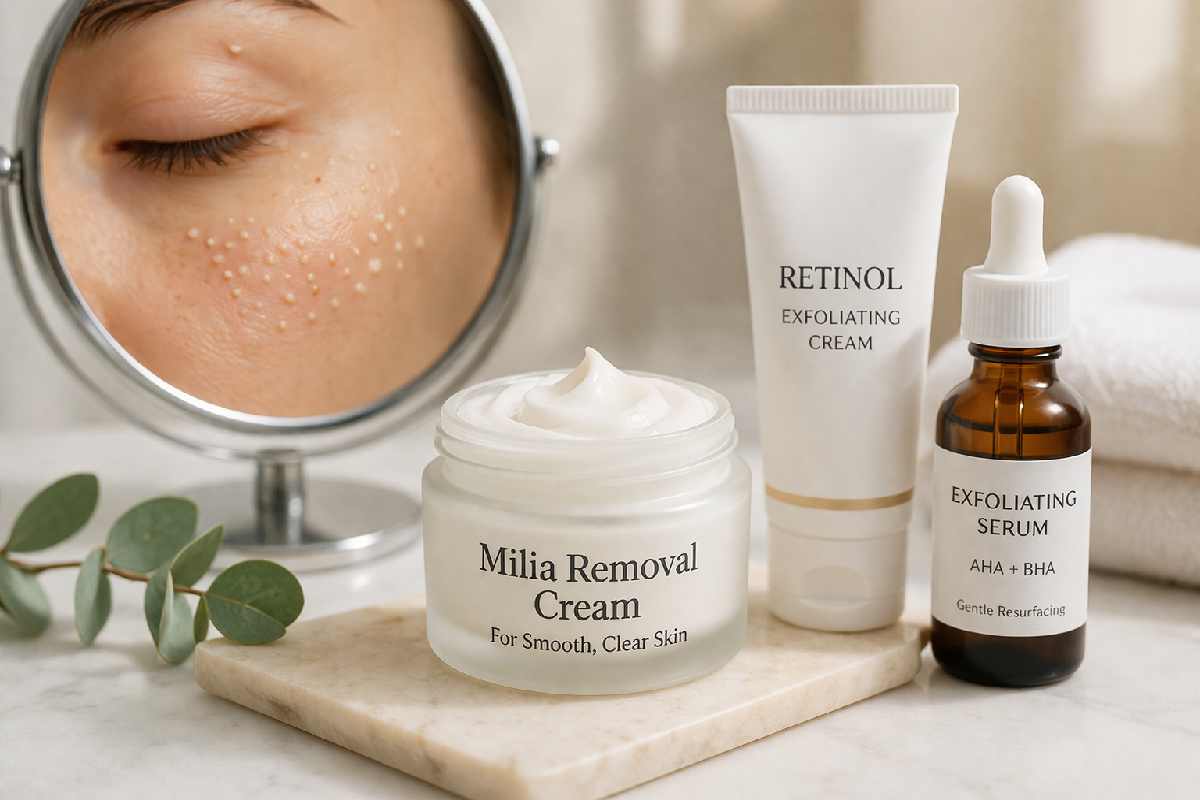
If you’ve ever noticed tiny white bumps around your eyes, cheeks, or forehead that just won’t go away, there’s a good chance you’re dealing with milia.
They can look a bit like whiteheads, but they’re not the same thing. That’s exactly why regular acne treatments don’t always work — and in some cases, they can make your skin more irritated.
So, what is the best milia removal cream?
The short answer: the best creams for milia usually contain ingredients that speed up skin cell turnover and gently exfoliate trapped keratin, such as retinol, salicylic acid, lactic acid, or adapalene.
But not every cream is right for every face — especially if your milia is around the under-eye area, where skin is thinner and more sensitive.
This guide breaks down what actually helps, what to avoid, and how to choose the right milia cream for your skin.
Milia are small, hard, white or yellowish bumps that form when keratin gets trapped under the skin.
They often appear on:
Unlike pimples, milia usually:
That’s why squeezing them usually doesn’t work — and often leaves irritation behind.
Milia can show up for a few different reasons.
Some people are also simply more prone to milia, especially if they use rich occlusive creams or have slower skin turnover.
The best cream is not necessarily the strongest one. It’s the one that helps clear trapped keratin without irritating your skin barrier.
Retinol is one of the most commonly recommended ingredients for milia because it helps your skin shed old cells more efficiently.
This can reduce the chance of keratin getting trapped under the surface.
Good for:
Best for:
Chemical exfoliants can help loosen buildup on the skin surface.
Good options include:
These ingredients help prevent the skin from becoming too congested.
This is one of the most overlooked causes of milia — especially around the eyes.
If you’re using:
…you may be making the problem worse.
Look for products labeled:
If you’re scanning labels, these are the ingredients worth looking for.
Best for:
Why it helps:
Retinol encourages faster skin renewal, which may help trapped keratin work its way out over time.
Best for:
Why it helps:
Salicylic acid is oil-soluble and helps clear buildup, making it useful if your milia is mixed with congestion.
Best for:
Why it helps:
Lactic acid exfoliates more gently than stronger acids and can help improve texture without being overly harsh.
Best for:
Why it helps:
Adapalene is a retinoid that helps regulate skin turnover and may be effective for persistent bumps.
Best for:
Why it helps:
Urea softens hardened buildup and can improve skin smoothness over time.
Instead of chasing one “miracle” cream, it’s smarter to choose by skin concern.
Choose:
Avoid:
Tip: The under-eye area is delicate. Start slowly and patch test first.
Choose:
Avoid:
Choose:
Avoid:
Choose:
Stubborn milia often takes time. If it doesn’t improve after a few months, it may need professional extraction.
Even a good cream can backfire if you use it too aggressively.
Morning
Night
If you use retinol or acids without sunscreen, you may end up with more irritation and slower healing.
This matters just as much as treatment.
A lot of people damage their skin barrier trying to “force” milia out. That usually just causes redness and inflammation.
This depends on:
If the bump is very hard, deep, or long-standing, topical creams may only help partially.
Yes — and prevention is often easier than removal.
If you’re prone to milia, a simple routine usually works better than a complicated one.
Many people treat milia like acne and get frustrated when nothing changes.
If you’re not sure what you have, it’s best to avoid aggressive treatment until you know.
Creams can help, but they don’t solve every case.
You should consider seeing a dermatologist if:
Dermatologists can remove milia with a sterile extraction technique, which is often the fastest option for stubborn bumps.
The best milia removal cream is usually one that contains retinol, adapalene, salicylic acid, or gentle exfoliating acids — and matches your skin type.
The biggest mistake is trying to remove milia too aggressively.
A smarter approach is:
gentle exfoliation + consistent skincare + patience
That’s what actually gives you the best chance of smoother, clearer skin.
The best milia creams usually contain retinol, salicylic acid, lactic acid, or adapalene to help improve skin turnover and reduce trapped keratin.
Yes, retinol can help reduce milia over time by encouraging the skin to shed dead cells more efficiently.
Salicylic acid may help, especially if your skin is oily or congested, but it works best on more superficial milia.
A gentle low-strength retinol or lightweight exfoliating eye-safe formula is usually best. Avoid harsh acids too close to the eyes.
It’s not recommended. Milia are usually hard and sit under the skin, so squeezing can cause irritation or scarring.

I’m Mohammed Shareef — editor and Admin of healthglowera. I simplify topics like beauty, skincare, haircare, wellness,tech,gadjets and online safety into clear, practical advice that readers can actually use. I focus on creating helpful, trustworthy content backed by research and real-world insights. You can reach me at contact@healthglowera.com



Sign up to receive exclusive content updates, fashion & beauty tips!

Copyright © 2026 All Rights Reserved By Health Glowera